Stepping into the world of healthcare management is a bit like becoming a conductor of an orchestra where every instrument is a different department—and the stakes are human lives. An Advanced Certificate in Healthcare and Hospital Management (ACHHM) is designed to turn those with a medical or business background into strategic leaders.
Let us break down what you will bring to the table and why "skills" are not quite the same as "competencies."
Why an Advanced Certificate is Your Passport to the C-Suite
The days when hospitals were managed solely by the most senior doctor on staff are fading. Today, the modern hospital is a technological and logistical marvel that requires a specific breed of leader.
For the graduate, an Advanced Certificate is the bridge between academic theory and the "controlled chaos" of a ward. For the working professional, it is the "re-skilling" needed to stop looking at a hospital as a building and start seeing it as a complex ecosystem.
The true value of this certification is not the paper—it is the shift in mindset. You learn that Administration is not just "paperwork"; it is the invisible glue that ensures a surgeon has the right tools, a patient has a clean bed, and the hospital stays financially solvent to serve the community for another decade.
Must-Have Competencies After Your Advanced Certificate
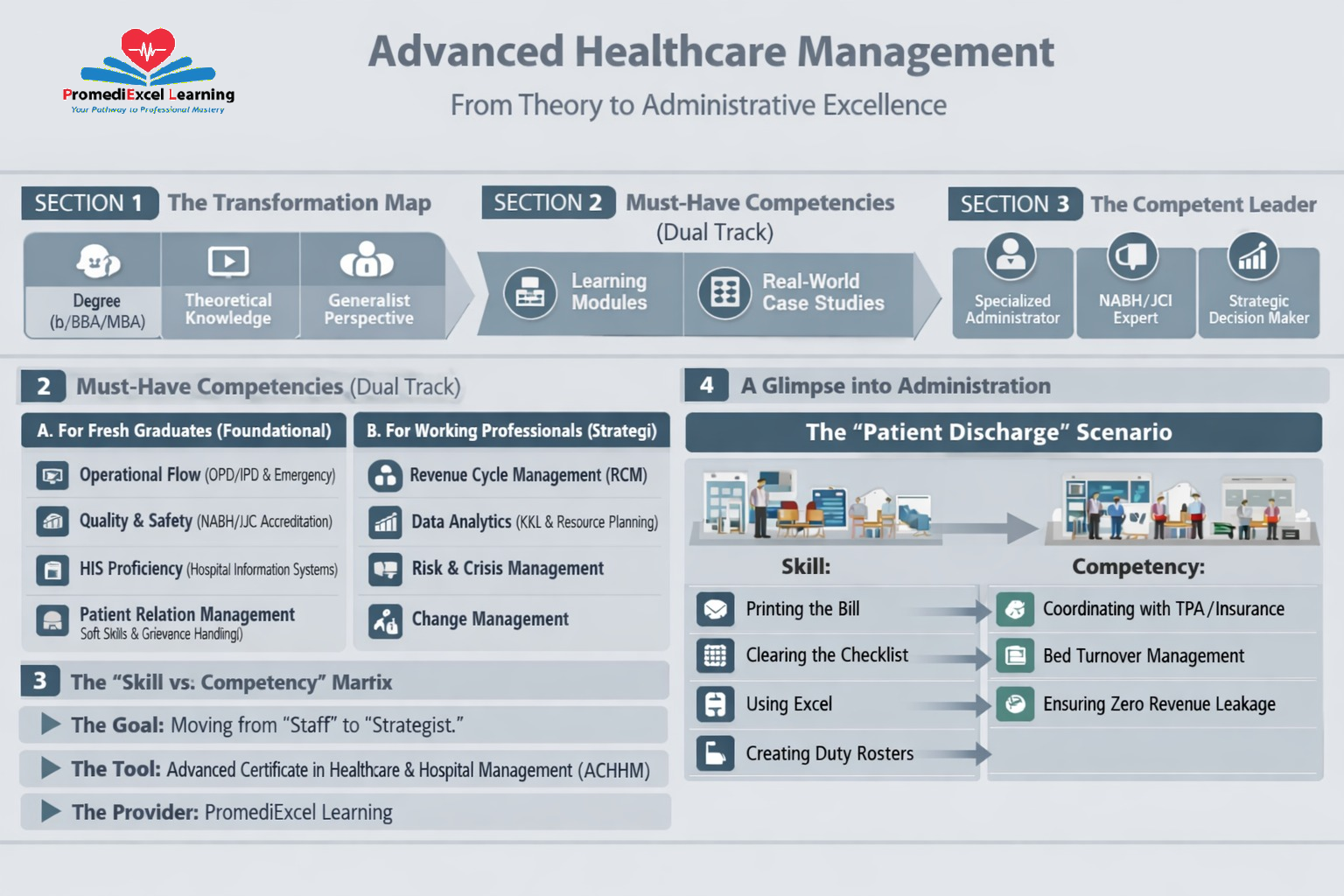
After completing an ACHHM, you are expected to move beyond basic supervision into strategic leadership. Here are the core pillars:
1. Strategic Healthcare Planning
It is no longer just about today’s patient flow. You must be able to forecast healthcare trends, manage facility expansion, and align hospital goals with government health regulations.
2. Financial Stewardship & Revenue Cycle Management
In healthcare, "no margin, no mission." You need the competency to manage complex insurance billing, optimize resource allocation, and understand the ROI of expensive medical technology.
3. Quality & Patient Safety (QPS)
This is the "North Star" of hospital management. You will need to master:
Six Sigma or Lean methodologies to reduce clinical errors.
Accreditation standards (like JCI or NABH) to keep the hospital licensed and reputable.
4. Health Informatics & Data Literacy
You do not need to be a coder, but you must be able to interpret Data Analytics.
Understanding the Difference: Skill vs. Competency
In hospital administration, confusing these two terms is common. However, the difference is what separates an "employee" from a "leader."
1. What is a Skill? (The "How-To")
A skill is a specific, learned ability to perform a task. It is technical and often binary—you either can do it, or you cannot.
Example: Using Microsoft Excel to track inventory.
Example: Conducting a basic fire safety drill.
Example: Preparing a duty roster for nurses.
2. What is a Competency? (The "Effectiveness")
A competency is the integration of skills, knowledge, behaviours, and judgment. It is the ability to apply a skill successfully in a real-world, unpredictable environment.
Example: Instead of just "Inventory Management" (Skill), a competent administrator practices "Supply Chain Optimization" (Competency)—ensuring that life-saving drugs never stock out while simultaneously reducing the hospital's holding costs.
A Glimpse of Administration: The "Discharge" Scenario
To understand how Skills and Competencies work together in hospital administration, look at the Patient Discharge Process:
| The Element | The Skill (Technical) | The Competency (Managerial) |
| Action | A staff member knows how to generate the final bill on the software. | The Administrator identifies that the "discharge delay" is due to slow TPA approvals. |
| Behaviour | Checking the boxes on the discharge summary. | Communicating with the insurance provider and the clinical team to clear the bed for a waiting ER patient. |
| Result | A bill is printed. | Bed Turnover Optimization: The hospital serves more patients, revenue increases, and the patient leaves happy. |
At PromediExcel Learning, our Advanced Certificate is designed to turn your Skills (what you know) into Competencies (what you can achieve).
In the administrative world, a skill might get you hired, but your competency determines how high you will rise in the hospital hierarchy
Stop collecting certificates and start building competencies. Our latest blog dives into how the Advanced Certificate in Healthcare and Hospital Management transforms graduates and professionals into industry leaders
.png)



.jfif)
.jfif)